Use Cases
Omni-Channel Brand Sentinel
Secure Your Social Reputation & Scale Capacity
Omni-Channel Brand Sentinel
Secure Your Social Reputation & Scale Capacity
The Problem
As your brand scales, every new follower brings more DMs and comments. What should be a community asset becomes a "notification debt." Teams need to chose between staying close to their people or protecting their focus.
Missed messages breaks trust, and constant app-switching kills deep work.
The Problem
As your brand scales, every new follower brings more DMs and comments. What should be a community asset becomes a "notification debt." Teams need to chose between staying close to their people or protecting their focus.
Missed messages breaks trust, and constant app-switching kills deep work.
What the Agentic Workflow Does
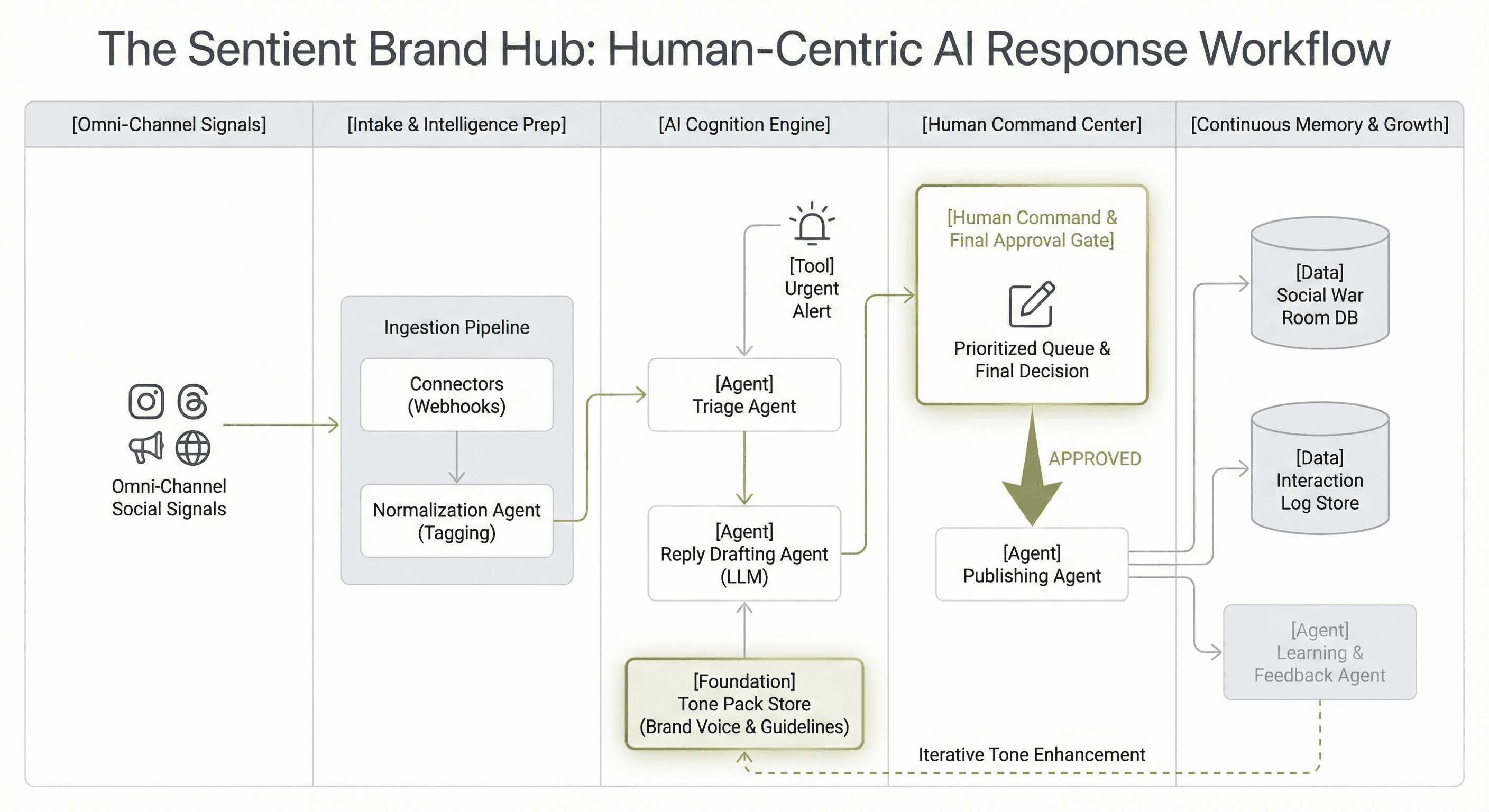
Always-On Brand Voice: The AI Agent autonomously drafts replies to DMs and comments 24/7, using a custom Tone Pack trained on your brand’s unique voice (warmth, humour, and boundaries included).
Intelligent Triage: It filters noise from signal, auto-classifying messages as "Support," "Collab," or "Risk," so you only see what truly matters.
Safety First: Sensitive topics trigger a "Human Review" alert. You get a daily "T+1 Brief" of all interactions, ensuring you stay in control without being in the weeds.
Always-On Brand Voice: The AI Agent autonomously drafts replies to DMs and comments 24/7, using a custom Tone Pack trained on your brand’s unique voice (warmth, humour, and boundaries included).
Intelligent Triage: It filters noise from signal, auto-classifying messages as "Support," "Collab," or "Risk," so you only see what truly matters.
Safety First: Sensitive topics trigger a "Human Review" alert. You get a daily "T+1 Brief" of all interactions, ensuring you stay in control without being in the weeds.
What the Agentic Workflow Does
Always-On Brand Voice: The AI Agent autonomously drafts replies to DMs and comments 24/7, using a custom Tone Pack trained on your brand’s unique voice (warmth, humour, and boundaries included).
Intelligent Triage: It filters noise from signal, auto-classifying messages as "Support," "Collab," or "Risk," so you only see what truly matters.
Safety First: Sensitive topics trigger a "Human Review" alert. You get a daily "T+1 Brief" of all interactions, ensuring you stay in control without being in the weeds.
ROI & Value
Capacity: Designed to cut manual triage time by 70%, turning "inbox zero" from a dream into a daily baseline.
Reputation: Ensures no customer is left on "read," building a responsive, premium brand image.
Asset: Transforms support from a cost center into a continuous engagement engine.
ROI & Value
Capacity: Designed to cut manual triage time by 70%, turning "inbox zero" from a dream into a daily baseline.
Reputation: Ensures no customer is left on "read," building a responsive, premium brand image.
Asset: Transforms support from a cost center into a continuous engagement engine.
AI Creative Co-Pilot
Content Flow Automation Studio
AI Creative
Co-Pilot
Content Flow Automation Studio
The Problem
Your community is constantly telling you what they want: in DMs, comments, and support tickets.
But these "Gold Nuggets" of insight are lost in scattered screenshots.
Meanwhile, your creative team stares at blank pages, struggling to churn out fresh content that resonates. The gap between "User Signal" and "Brand Content" is where growth stalls.
The Problem
Your community is constantly telling you what they want: in DMs, comments, and support tickets.
But these "Gold Nuggets" of insight are lost in scattered screenshots.
Meanwhile, your creative team stares at blank pages, struggling to churn out fresh content that resonates. The gap between "User Signal" and "Brand Content" is where growth stalls.
What the Agentic Workflow Does
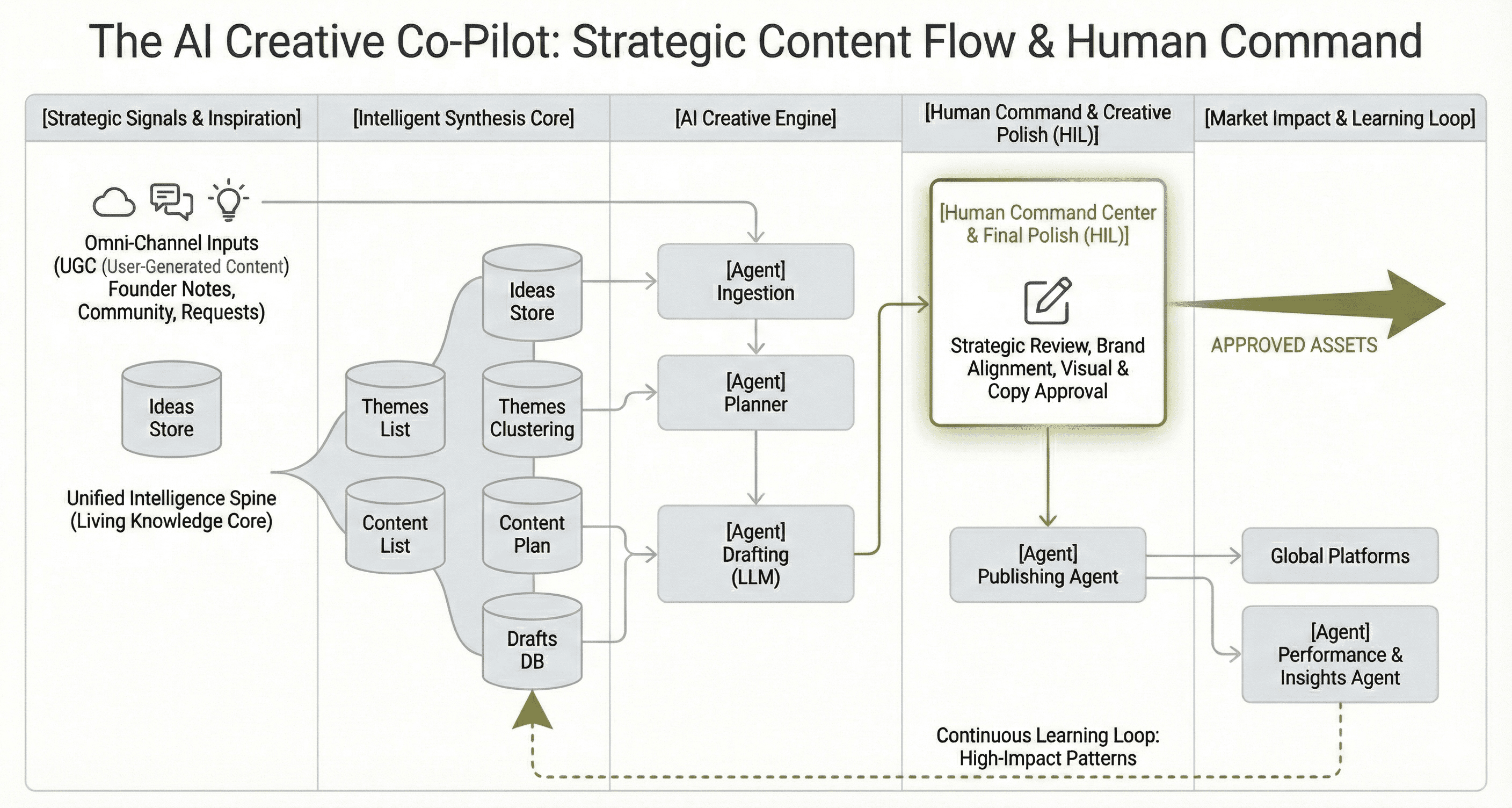
Active Listening: The AI Agent continuously monitors and captures user sentiments, questions, and feedback across all channels, organizing them into a live "Insight Library."
From Signal to Post: The AI Agent detects recurring themes (e.g., "everyone is asking about X") and instantly generates multi-format drafts (Instagram captions, Threads, video scripts) that address these real user needs.
Visual Direction: It produces structured visual briefs for your designers, ensuring every piece of content is strategically aligned with what your users are actually asking for.
What the Agentic Workflow Does
Active Listening: The AI Agent continuously monitors and captures user sentiments, questions, and feedback across all channels, organizing them into a live "Insight Library."
From Signal to Post: The AI Agent detects recurring themes (e.g., "everyone is asking about X") and instantly generates multi-format drafts (Instagram captions, Threads, video scripts) that address these real user needs.
Visual Direction: It produces structured visual briefs for your designers, ensuring every piece of content is strategically aligned with what your users are actually asking for.
ROI & Value
Relevance: The AI-Content strategy is fueled by real-time user signals. This ensures users feel heard, transforming your community into a strategic asset that automatically steers your brand to be more user-centered.
Throughput: Designed to automate the "First Draft" grind, freeing creatives to focus on polish and strategy.
Cycle: Creates a virtuous loop where "Listening" automatically fuels "Publishing," keeping your brand calendar full and relevant.
ROI & Value
Relevance: The AI-Content strategy is fueled by real-time user signals. This ensures users feel heard, transforming your community into a strategic asset that automatically steers your brand to be more user-centered.
Throughput: Designed to automate the "First Draft" grind, freeing creatives to focus on polish and strategy.
Cycle: Creates a virtuous loop where "Listening" automatically fuels "Publishing," keeping your brand calendar full and relevant.
Dynamic Pricing
Co-Pilot
The Strategic Deal Engine
Dynamic Pricing
Co-Pilot
The Strategic Deal Engine
The Problem
In complex B2B sales, pricing is a multi-dimensional strategy involving contract history, live costs, and relationship context. Sales leaders currently invest significant time synthesizing these diverse inputs to ensure every deal aligns with long-term profitability and client status.
This comprehensive due diligence is essential but time-intensive, competing with time needed for client engagement.
The Problem
In complex B2B sales, pricing is a multi-dimensional strategy involving contract history, live costs, and relationship context. Sales leaders currently invest significant time synthesizing these diverse inputs to ensure every deal aligns with long-term profitability and client status.
This comprehensive due diligence is essential but time-intensive, competing with time needed for client engagement.
What the Agentic Workflow Does
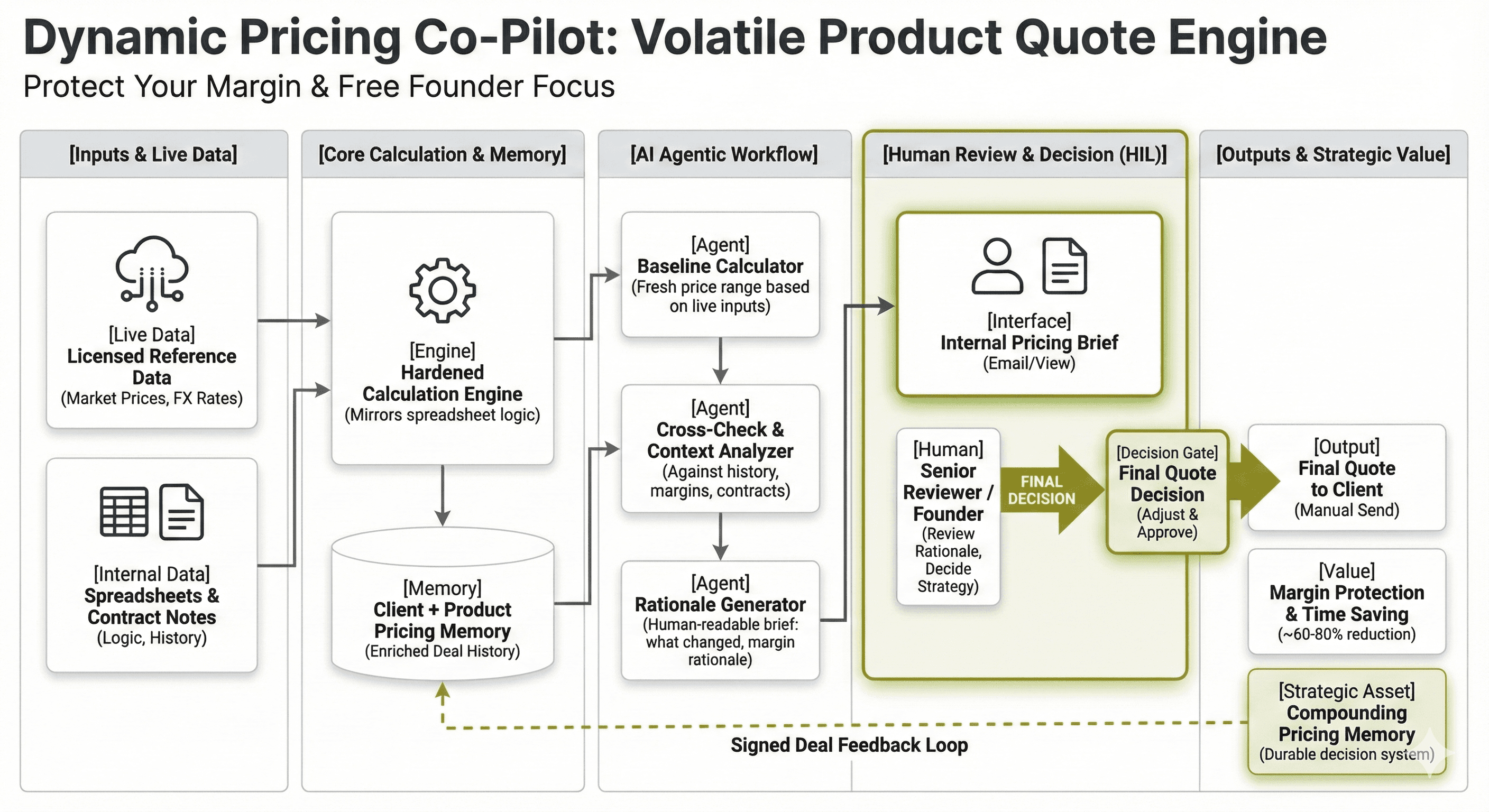
Total Context Integration: The AI Agent operates as an institutional memory bank. It actively integrates client status, active contract terms, and historical discount patterns, ensuring every new quote naturally aligns with the depth of the long-term relationship.
Strategic Synthesis: The Agent synthesizes real-time cost data with your specific profit margin rules and sales strategy. It proactively constructs pricing structures designed to optimse win rates while upholding strict profitability standards.
Complete Deal Architecture: The system generates the full commercial package, including the financial figures, the sales narrative, and the strategic rationale. It prepares comprehensive internal briefings and client-facing proposals, ready for final human review.
What the Agentic Workflow Does
Total Context Integration: The AI Agent operates as an institutional memory bank. It actively integrates client status, active contract terms, and historical discount patterns, ensuring every new quote naturally aligns with the depth of the long-term relationship.
Strategic Synthesis: The Agent synthesizes real-time cost data with your specific profit margin rules and sales strategy. It proactively constructs pricing structures designed to optimse win rates while upholding strict profitability standards.
Complete Deal Architecture: The system generates the full commercial package, including the financial figures, the sales narrative, and the strategic rationale. It prepares comprehensive internal briefings and client-facing proposals, ready for final human review.
ROI & Value
Pure Focus: Designed to liberate sales teams from 85% of manual prep work, allowing them to dedicate their energy entirely to client relationship management and closing deals.
Deal Velocity: Accelerates the sales cycle by allowing for the rapid generation of complex, accurate proposals that reflect total commercial context.
Unified Margin Intelligence: Ensures every active deal aligns with the company’s latest cost structures and margin goals.
ROI & Value
Pure Focus: Designed to liberate sales teams from 85% of manual prep work, allowing them to dedicate their energy entirely to client relationship management and closing deals.
Deal Velocity: Accelerates the sales cycle by allowing for the rapid generation of complex, accurate proposals that reflect total commercial context.
Unified Margin Intelligence: Ensures every active deal aligns with the company’s latest cost structures and margin goals.